
Welcome to the inaugural issue of Auxo Waypoints, a quarterly guide to navigating the complex, slow-moving, and occasionally surprising machinery of federal acquisitions, and the Auxo team’s official newsletter.
We work with companies and investors building within Government systems, and with the public servants working to help them succeed. That means translating intent into contract language, policy into execution, and capability into something that can actually be bought.
Each issue, we’ll share insights from our day-to-day, highlight teams doing thoughtful work, and offer tools we’re using or questions from our own practice. Some of it may feel familiar, and some may provide new context, especially if you're just getting started.
We’re glad you’re here — let’s grow together.
Cost-Plus Thoughts: Notes on Federal Contracting
What’s a Seat Worth? Pricing SaaS Products for the Federal Government
No one knows how to price software.
Seriously. I get asked constantly how to model pricing for software—especially SaaS—for dual-use companies selling to the Government. And for good reason: it’s tricky.
Some companies are doing SBIRs or STTRs where the core software is already built — they’re just developing a Government-specific module or interface. (Let’s not get into whether that qualifies as R&D-y enough for those dollars, that’s a different post.) Others are building entirely new software but want to retain IP. Some have no idea where to start. And some already have commercial or Government traction, but now find themselves pulled into higher-dollar, sole-source negotiations for the first time, and suddenly, the Government is asking questions about something called “price fair and reasonableness,” which may or may not, in fact, be made-up words.
Worse: sometimes the Government thinks buying SaaS means buying it as a service under their standards—as in a labor-based service acquisition.
Before we move on, we also need to talk about FAR 2.101. There is currently no definition of "commercial software." There’s a definition for commercial product. There’s a definition for commercial service. Software? Nope. It's dealer's choice. Which makes everything way harder than it needs to be.
So when we talk about pricing SaaS, what exactly are we even pricing?
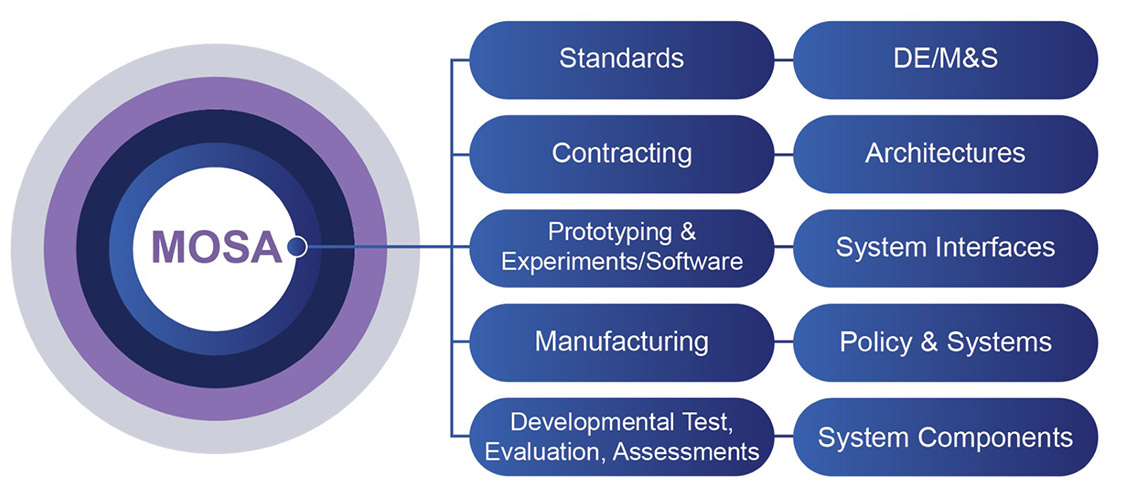
Are we talking about the platform license? More and more frequently, this is becoming challenging due to the Government's (and by extension, the Primes') increased reluctance to buy annual licenses for bespoke, new, or limited-source software. This is rooted in an understandable fear--they’re worried about vendor lock-in and want to "own something" at the end of a contract. However, this buying strategy fails to consider alternative methods of acquiring software — such as requiring vendors to comply with MOSA standards or negotiating more favorable rights to interfaces or specific components needed for future upgrades, integration with other systems, or lifecycle adaptability. And it begs the question: what does the Government think the Primes have been doing for decades? Or is this just a case of overcorrection?
Then there’s the whole hosting issue. Especially for AI tools: where is the software hosted? What happens to the data? Is it in the cloud or on-prem? What’s the impact level, and which network are we deploying on? That means deployment costs. It means ATO timelines. It means sustainment, security, dev cycles, and patching.
So now, in addition to licensing, you have:
- Deployment & hosting costs
- Customization or feature development (aka NRE)
- Annual maintenance or sustainment
- Help desk / user support
And how do you price all that?
- Per seat? What if it’s a classified network and you can’t verify individual user access?
- Usage-based? What if the Government doesn’t know what they need up front?
- Fixed price? That gets risky if you’re scaling or selling anything remotely consumption-based
Also, the Government can't budget for open-ended liabilities--and this matters when structuring a deal. And they hate complex pricing models. A la carte or t-shirt sized pricing is popular too, but it requires either historical data or blind confidence, and can get out of control quickly. It's also difficult to structure contractually. So even when a pilot effort succeeds—say, 10 users on a single network—it gets cost-prohibitive to scale across a whole service or department.
Then there’s evaluation. The Government also doesn’t know how to evaluate software pricing. Much like medicine, where the first pill costs billions and every pill after costs pennies, software has high upfront development costs and low marginal costs. Yet industry (and especially investor) expectations for commercial SaaS companies are that margins will be high. Add it all together, and when it comes to pricing, both sides flounder.
So what’s the solution?
First, stop trying to buy software licenses like labor-based service contracts. SaaS doesn’t mean time and materials. It means access. You’re buying capability, not labor hours.
Second, break it up:
- Separate implementation and NRE from license costs
- Clearly define and delineate required sustainment and support
- Accept that commercial contracts and pricing models may not map perfectly to government formats
And that’s okay. It’s solvable. But it does require reading. And possibly thinking.
Also, an annual license is not vendor lock.
(Ahem... did I mention MOSA?)
The Government need GPR or unlimited rights for everything just to avoid vendor lock. You can—and should—negotiate rights to the interfaces or Government-specific modules without demanding ownership of the full source code (especially not source code for commercial computer software).
Let me put it this way: you pay for access to Microsoft Word. You own every document you create. But you don’t own Word. Nor should you. Imagine trying to maintain your own build of Word: feature updates, security patches, compatibility fixes/issues. That’s a full-time software development team. That’s your life now, Government. And quite frankly, you do not have the resources or will to live that way.
Take it a step further. Let’s say a company builds a revolutionary new communication capability. It gets implemented as software. Call it... email. That productized version? Outlook. Would you stop your team from using email because you don’t want to get "locked in" to Outlook? Of course not. And yet I have heard first-hand a Government customer say the equivalent of: "This is cool tech, but we’d rather stick to pen and paper messages transmitted via rats running around our office than risk vendor lock on email."
This is madness.
So. To recap:
- Break out license, NRE, and sustainment costs;
- Use commercial pricing models or data for evaluation or comparison wherever possible—even if just at the cost element level;
- Stop forcing SaaS into service acquisition or labor-based contract structures; and
- Recognize that buying capability is different from buying labor;
So please: do a little homework on what you’re buying. It will save everyone time, money, and a whole lot of frustration.
And for the Government folks out there, look — yes, Government teams are overtasked, understaffed, and often stuck with tools built for a different era. But that’s exactly why the Government needs to understand software pricing and buying.
A note for the companies out there--If you’re selling software for the first time (or for the first time to a savvy government customer who’s asking you to explain your pricing), remember: it’s up to you to help them get to a position where they can determine your price is fair and reasonable. That doesn’t mean you have to give the lowest possible price the Government can squeeze out of you. In fact, a price that is too low may signal other issues with your proposal. What you want is a price that makes sense for what you're delivering. There are a number of ways to support that, and if you’re not sure how to start or where to look, you can start with FAR 15.4. Or if the idea of reading the FAR sounds overwhelming or just incredibly boring, reach out to Team Auxo. We can help.
Lastly, for anyone dreading their next price volume, or any budding pricing nerds out there that want to learn more, here are some of my favorite resources, as well as a few other relevant links from this post:
 |
 |
 |
Apparently This Resonated (We’re Not Mad About It)
Each quarter, we'll highlight the blog post or article that seemed to resonate most with our readers. For this issue that post was...
Hiring the Right People

Owning, operating, or being a part of a small business is a unique and challenging experience. One specific challenge revolves around hiring. My colleagues and I have seen companies take hiring very seriously and we have seen them simply “fill a position” and there is a distinct difference in success depending on which option a company chooses. Here are my thoughts on why you should care about hiring and why you should be willing to invest as much as you can in the right people.
For small businesses working with the Department of Defense (DoD), success is determined by more than just securing the contract. Execution, compliance, and reputation all play a critical role in ensuring that the business not only fulfills its obligations but also positions itself for future opportunities. One of the most important factors in this equation is hiring the right people. This means not only hiring employees with the necessary qualifications but also those with the right temperament and attitude to thrive in a high-stakes, structured, and often complex environment.
The Importance of Hiring Qualified Professionals
DoD contracts often come with stringent technical requirements, security clearances, and regulatory compliance mandates. Hiring employees who possess the requisite skills, certifications, and experience is crucial. Small businesses need professionals who understand government regulations, cybersecurity standards, logistics, and other specialized fields. Without qualified personnel, a company risks inefficiencies, contract violations, and reputational damage that could hinder future business opportunities.
Beyond qualifications, however, there is another equally important factor—hiring employees with the right mindset.
The Right Temperament for DoD Contracting
Working with the DoD requires adaptability, precision, and a commitment to excellence. Government projects often involve strict deadlines, detailed documentation, and the ability to navigate bureaucratic processes. Employees must be able to handle stress, work within a structured chain of command, and communicate effectively with government personnel. A lack of discipline or the inability to follow protocol can lead to costly mistakes and strained relationships with contracting officers.
Moreover, problem-solving skills are invaluable. The nature of defense contracts means that unexpected challenges will arise. Employees who are resourceful, proactive, and solution-oriented will help the company navigate complexities more effectively than those who require constant oversight.
The Power of a Positive Attitude
Attitude plays a significant role in the success of a small business’s DoD contract performance. Employees who are mission-driven, dedicated to service, and take pride in their work foster a culture of accountability and excellence. A positive work ethic improves collaboration, enhances productivity, and ensures that problems are met with solutions rather than complaints.
Furthermore, customer service is a crucial aspect of government contracting. How a business interacts with DoD representatives, prime contractors, and other stakeholders can determine whether it secures repeat contracts. Employees who approach their work with professionalism, respect, and a can-do attitude will strengthen the company's reputation and credibility in the industry.
Avoiding the Cost of a Bad Hire
A poor hiring decision can have severe consequences, including missed deadlines, contract non-compliance, and even legal or financial penalties. High turnover rates can disrupt operations, increase training costs, and reduce overall morale. Small businesses, in particular, cannot afford to make costly hiring mistakes when operating within the rigid framework of government contracting.
Building a Strong Team for Long-Term Success
To position a small business for success with the DoD, leaders should focus on developing a hiring strategy that prioritizes both skill and character. This includes:
-
Defining Clear Hiring Criteria: Ensure that job descriptions reflect both technical requirements and desired soft skills such as adaptability, integrity, and teamwork.
-
Leveraging Veteran Talent: Veterans bring invaluable experience, discipline, and an understanding of military culture, making them great assets in DoD contracting roles.
-
Implementing a Rigorous Hiring Process: Utilize structured interviews, background checks, and scenario-based assessments to gauge a candidate’s qualifications and temperament.
-
Fostering Continuous Training and Development: Even well-qualified employees benefit from ongoing education to keep up with DoD regulations and industry best practices.
Conclusion
Success in government contracting, particularly with the DoD, goes beyond securing contracts—it requires a team that can execute effectively, maintain compliance, and build strong relationships. Hiring the right people—those who are both highly skilled and have the right temperament—can make all the difference in a small business’s ability to thrive in the defense sector. By prioritizing both qualifications and attitude, small businesses can position themselves as reliable, competent partners for the Department of Defense, ensuring long-term growth and stability in the industry.
Keep Moving Forward,

Here's the link to Haley's original post, as well as her LinkedIn.
A few more that sparked interest (or at least debate):
- In Surviving the Shift: How to Navigate the Federal Shake-up, Austin tackles the confusion surrounding today’s federal transitions with practical, clear-sighted advice for small and non-trad GovCons. From budget realignments to cultural resilience, Austin offers a timely look at how businesses can stay relevant, mission-aligned, and strategically agile through this period of upheaval.
- In Free Resources to Help You Through the Federal Marketplace, Haley delivers a valuable toolkit of no-cost assets for newcomers and veterans alike in the USG acquisition space. She rounds up essential portals like SAM.gov, Vulcan, and agency archives and offers her expert guidance on how to leverage them effectively.
- Throwback alert! Megan’s Is It Worth It to Protest? remains a relevant and (hopefully) empowering guide for SBs grappling with disappointing proposal results and less-than-clear debriefs. Drawing from her experience as a former KO, Megan demystifies the protest process by laying out when to file, how to assess legitimacy, and why companies shouldn’t shy away from using the system when it counts.
Partner Spotlight: Rob Miller
At Auxo, we believe that transforming the GovCon space requires an abundance mindset: one that celebrates shared wins and sparks a thriving community of practice. Each quarter, we'll spotlight a partner who embodies this spirit, whether a former teammate, investor, or mission-aligned organization helping to shape a stronger, more resilient industrial base
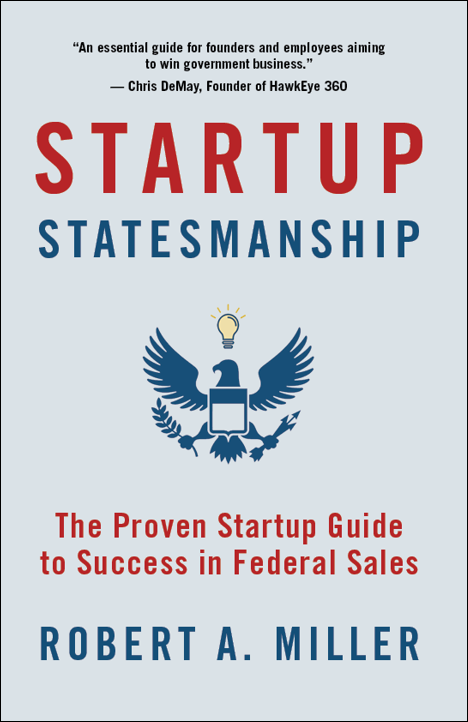
Rob Miller, author of Startup Statesmanship, offers an essential guide for startups aiming to navigate the complexities of federal sales. Drawing from his extensive experience, Rob provides practical advice and resources to help companies build substantial pipelines and secure multimillion-dollar deals. Our team at Auxo puts this on the top of your list of “must reads” when engaging with the federal marketplace!
Austin's Coaching Corner
Each quarter, one of our founders and Auxo’s CEO, Austin DeLorme, shares reflections from her growing coaching practice. After more than a decade inside the defense innovation ecosystem, she’s now raising two boys, running two businesses, & advising others doing the same. Her focus has shifted to the people behind the work — the ones making things run. This section is for those navigating GovCon without a blueprint: ambitious founders, working parents, and anyone trying to stay aligned while moving fast. It’s about sharing real tools, asking better questions, and creating space to grow without burning out. This quarter, Austin is writing about Clarity.
Clarity isn’t just a luxury—it’s the foundation for making an impact without losing yourself in the noise. As professionals, we juggle competing priorities, shifting landscapes, and the constant demand to be decisive. Without clarity, we risk getting swept up in urgency rather than importance, mistaking motion for progress. The best leaders don’t have fewer challenges; they just navigate them with sharper focus. As James Clear puts it, “You do not rise to the level of your goals. You fall to the level of your systems.” And systems—whether for business, leadership, or life—only work when built on clarity. When we know what truly matters, we move with intention, invest our energy wisely, and cut through distractions that dilute our impact.
For me, clarity is the reason I can show up fully in both the work I do and the life I live. My mission in national security isn’t abstract; it’s about safeguarding the world my boys grow up in. This mission is important to me, and can easily pull me away from being the mom they need. While they don’t need me to be perfect—they need me to be present. And I can’t offer that if my mind is cluttered, stretched too thin, or chasing every possible path instead of the right one. Clarity is what lets me move forward with confidence, make hard decisions without hesitation, and create space for what matters most.
Top 5 Habits for Gaining Clarity
-
Define Your Priorities Daily – Start each day by asking yourself: What actually moves the needle? Clarity comes from knowing what deserves your time and what doesn’t.
-
Create Space for Deep Thinking – Block time in your schedule to think—not react. Whether it's a quiet morning walk, journaling, or even just five minutes of reflection, clarity thrives in stillness.
-
Simplify & Say No More Often – Complexity breeds confusion. If something doesn’t align with your mission or values, it’s a distraction. Clear priorities mean clear decisions.
-
Seek Outside Perspective – Clarity isn’t always a solo pursuit. Talk to mentors, peers, or trusted advisors who challenge your thinking and help you see blind spots.
Take Action & Iterate – Clarity isn’t found by overanalyzing; it’s created by moving forward. Take small, intentional steps, adjust as you go, and let experience refine your direction.
Also Worth Reading
Each quarter, we'll share a few pieces from partners, peers, or other thought leaders that made us pause. Pieces that stood out for being unusually clear, refreshingly honest, or just freakin' useful. Not endorsements, just intel.
New DoD IP Guidebook: The DoD just released a refreshed Intellectual Property Guidebook — a must-read for anyone navigating IP strategy in federal contracts, but lower your expectations going in.
AFWERX SBIR/STTR Portfolio Analysis by PwC: A sharp look by a phenmonenal team at AFWERX’s innovation investments via its SBIR/STTR program, this portfolio analysis from PwC lays out trends, focus areas, and other insights that matter for both startups and stakeholders in the defense innovation ecosystem.
"Modernizing Defense Acquisitions and Spurring Innovation" — Presidential Memorandum, April 2025. The White House is directing agencies to streamline acquisitions, reduce barriers to entry for small businesses, and accelerate tech adoption. You could call us experts in this space--we just call it a Tuesday. Worth a read if you want to see what the policy layer thinks progress should look like.
“Streamlining Federal Contracting: The Push to Acquire Products and Services at Speed and Scale” — Reuters, May 2025. It’s not every day you see our world show up in a mainstream outlet without getting lost in translation (I'm having flashbacks to when War Dogs came out in theaters). This one nails the tension between urgency and bureaucracy (and reminds us why we do what we do!).
"Giants and the Myth of America’s New Defense Consolidation" — War on the Rocks, June 2025. A counterpoint to the “new primes, same as the old primes” narrative. If you’ve ever built a dual-use startup (or advised one), you’ll recognize the tension that's at play here--scale without selling out, acquisition without consolidation, etc. We think this gets closer than most.
"The 2025 War on the Rocks Summer Fiction Reading List" — War on the Rocks, June 2025. Please pardon the repeat from WotR, but what's a summer reading list without... well, a summer reading list? The Auxo Team can personally vouch for the quality and relevance of Ms. Yarros' treatise on military education.
Things We're Tracking
This section has no rules. Sometimes it’s a product launch, sometimes a world event or conference, sometimes a birthday. If it’s on our radar (and maybe should be on yours) it shows up here.
NCMA World Congress 2025
Gaylord Texan Resort, Grapevine, TX
July 13 – 16, 2025
The premier gathering for contracting profs—mandatory if you care about how regulatory trends actually show up in templates.
Hilton Head Government Contracts Week 2025
The Westin Hilton Head Island
July 28 – August 1, 2025
A perennial favorite for the GovCon crowd who still say “LCAT” at a family dinner like normal people should know what that means.
Air Force Association National Convention
Gaylord Convention Center, National Harbor M.D.
September 22 - 24, 2025
As surely as the crowd thins after lunch on Day 2, one of us (Megan) will misjudge parking, wear the wrong shoes, and blame everyone by happy hour on Day 1. Every year.
Government End of Fiscal Year
United States Government Acquisition and Procurement Offices Everywhere
September 30 2025
Also known in the "biz" as "National Leave Your Contracting Officer Alone Day." Unless you owe them something. Then you need to turn that in ASAP.
Association of the United States Army (AUSA) Annual Meeting
Washington D.C.
October 13 - 15, 2025
Only the Army would take up this much floorspace to show off new ways to make things go boom (or stuffed dogs). Either way--we aren't complaining.
Auxo ©
Auxo [awk-soh: to grow] started as a belief that there was a way to scale knowledge to grow public private partnerships and expand the commercial industrial base supporting defense and public good. Over the past year and a half, a vision has taken root, and we are excited to get more than one-off articles out into the ecosystem!
Auxo's goal is to build a community around the knowledge necessary for non-traditional partners to succeed without the cash, rapport, and knowledge that is readily available to industry primes. Primes play a major role, and will likely continue to do so, but expansion and diversification are critical, and the speed and agility of smalls and non-traditionals are essential.
Consultants and educators in this space do their very best, but individually cannot compete with large organizations able to attract and hire top talent in the hundreds, leading to teams with a diverse array of institutional knowledge and experience.
Abundance is the name of the game for small and non-traditional partners: the more success the federal market witnesses, the more chances it'll take. Auxo aims to start a movement of collaboration and knowledge sharing so we can all rise with the tide.
“Never underestimate the power of a small group of committed people to change the world. In fact, it is the only thing that ever has.” ~ Margaret Mead

Responses